-
 By Ces Mowthorpe: The story of the sky sailors - the men who pioneered a mode of air transport that today is virtually forgotten. During the first two decades of aviation pioneering (c.1890-1910), airshipmen greatly outnumbered aeroplane pioneers. But the great innovations in heavier-than-air aircraft, the advent of two world wars, and the bad publicity brought about by a few horrific airship disasters, Hindenburg and Shenandoah to mention two, changed the picture completely.
-
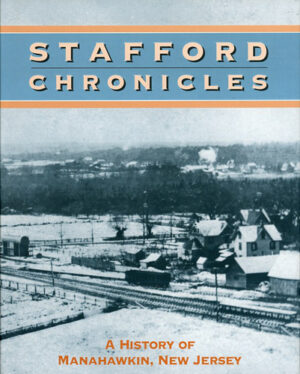 Stafford Chronicles—A History of Manahawkin, N.J.: This pictorial history explores a shore town whose coastal traditions and roots go back to before the Revolutionary War. Readers will relive the days of the Tuckerton and Long Beach Railroads: visit with world-renowned decoy carver Hurley Conklin; and discover the 3 “Docs”—Cramer, Hillard, and Lane. The book contains a remarkable collection of essays, reminiscences, memories, and photographs.
-
 By Kenneth W. Able, PhD.: Station 119 is the story of the mission of the men and women who work at the Rutgers University Marine Field Station. It is also the story of the station itself. While the station now may play a role in saving the planet, it began with a mission of saving lives. This is the fascinating history of a remote former Coast Guard station near Little Egg Inlet on the Jersey Shore and its reincarnation as a marine research facility. The station is now staffed by scientists and students studying the environment in the Jacques Cousteau National Estuarine Research Reserve (JCNERR), near Long Beach Island.
-
 By Patricia B. Mitchell: Get a taste of tea history in the first section of this book. The second section gives information about the kinds of tea. In the final section you have many recipes that will tempt you. The author has, also, included notes for you to learn even more about tea.
-
 By Michael S. Adelberg: On the Jersey Shore, the Revolutionary War was more than a contest between the Continental and British Armies. In this neglected region, locals divided into pro- and anti-independence camps that fought a tumultuous six-year war only intermittently tied to the larger conflict. This war brought unprecedented economic opportunity to the Jersey Shore’s formerly poor and secluded villages, as locals risked their savings on speculative salt-making ventures and risked their lives in privateer vessels. British ships bound for New York were hunted by smaller vessels lurking in shore inlets. Local leaders sought to find and punish stealthy “London Traders” smuggling provisions behind British lines, and militia battled so-called Pine Robber gangs that frequently bested them. Richly documenting and vividly narrating these events and others, award-winning historian Michael Adelberg explores the shore’s roll in America’s war for independence.
-
Out of stock
 By R. Marilyn Schmidt: Find out about the types of bats that live in the northeastern United States. The book tells how to solve bat problems, as well as how to remove them from inside a house and bat proof a home. Want to cut down on insects? Installing a bat house may be a safe and non-chemical way to get results. The author has included a list of sources to locate more information about bats.
-
Out of stock
 By Merce Ridgway: A native son of Barnegat Bay shares an insider’s chronicle of a culture that has all but disappeared. It is a story that celebrates the Shore and the Pine Barrens with music, folklore, philosophy and a genuine and deeply felt sensitivity.
-
 By Captain Robert Bennett, Susan Leigh Bennett, & Commander Timothy R. Dring: In 1854, two horrendous shipwrecks took place off the New Jersey coast. The Powhattan and the New Era were both American-flag sailing packet ships carrying hopeful European immigrants to new lives in America. The ships ran aground on the offshore sandbars along the shoreline between Sandy Hook and Little Egg Inlet, claiming the lives of many passengers and crew. The staggering casualties finally prompted calls from the public and politicians for reforms to the system for rescues that the federal government had in place. The tragedies ultimately resulted in changes that prevented countless similar deaths. This unique and gripping account offers minute-by-minute details of the deadly wrecks, their causes and their final outcomes.
-
 By Janis Gibson: This is an account of a particular branch of the Giberson family, the Gibersons of Old Dover. It is a compilation of biographical and genealogical facts, the end product of a quest to identify all the Gibersons associated with Dover between 1775-1830 and to understand how they fit together.
-
 By The Ocean County Sun (newspaper): The New Jersey shore areas are vulnerable to the wrath of nature. This book contains the story and photos of the March 1962 storm that devastated the area.
-
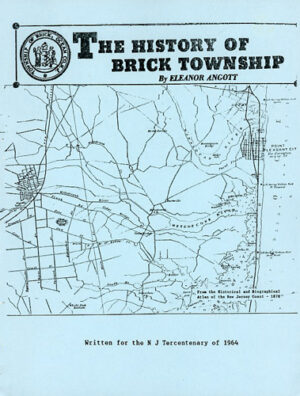 By Eleanor Angott: Written in 1964 as a series of newspaper articles for the New Jersey Tercentenary. The articles have been indexed and copied for this 1992 publication. It contains a comprehensive history of the area beginning in pre-revolutionary war times. The text is rich with family names, many of which are still common in the Brick Township of today. The publication contains an index.
-
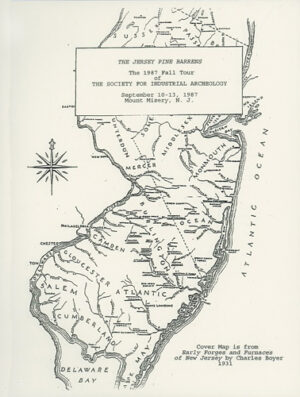 The 1987 Fall Tour of The Society For Industrial Archeology: The booklet provides an overview of the various industries which formed the culture of South Jersey. The first area covered of the southern part of New Jersey is the coastal area; fishing, oystering, and boat building. This includes the Atlantic shore and the Delaware Bay, which contain vast reaches of tidal marshes. The second area of investigation is that part of the outer coastal plain known as the Pine Barrens. A tract of at least 650,00 acres which supplied the mill seats and raw materials for iron, paper, glass, blueberries, and cranberries. In addition, the people who followed the bay, who worked the iron plantations; and who in later years became known as “Pineys” are included. Learn about at least three generations of the William Richards family who helped to create much of South Jersey’s history.
Call Us Today! (732) 341-1880