-
 By Lloyd R. Applegate: During his varied political career, William Augustus Newell served as governor of both New Jersey (1857-1860) and the Territory of Washington (1880-1884). His interests and talents ranged from medicine and agriculture to several terms in Congress. He was a friend of the Lincolns, and was appointed as an Indian inspector in the northwest. Of greatest benefit to those of us along the Jersey coast was his persistence in bringing about legislation that established life-saving stations along our coast.
 -
 By Gretchen F. Coyle & Deborah C. Whitcraft: Once located between Great Bay and Little Egg Harbor, along the New Jersey coast, Tucker's Island disappeared into the Atlantic Ocean. Sand dunes and native foliage once covered its eight miles. For generations, the Rider family kept the light illuminated, and the US Life-Saving Service provided aid to ships in distress. Two hotels were constructed by island men with building materials salvaged from local shipwrecks. Visitors arrived by sail or steam, and the popularity of Tucker's Island inspired real estate agents to sell worthless lots to unsuspecting buyers eager for their own piece of the shore. Storms battered the vulnerable island; the lighthouse toppled in 1927, the life-saving station washed away, and in 1932, the island was removed from tax records.
 -
 By Kenneth W. Able, PhD.: Station 119 is the story of the mission of the men and women who work at the Rutgers University Marine Field Station. It is also the story of the station itself. While the station now may play a role in saving the planet, it began with a mission of saving lives. This is the fascinating history of a remote former Coast Guard station near Little Egg Inlet on the Jersey Shore and its reincarnation as a marine research facility. The station is now staffed by scientists and students studying the environment in the Jacques Cousteau National Estuarine Research Reserve (JCNERR), near Long Beach Island.
 -
 By Ces Mowthorpe: The story of the sky sailors - the men who pioneered a mode of air transport that today is virtually forgotten. During the first two decades of aviation pioneering (c.1890-1910), airshipmen greatly outnumbered aeroplane pioneers. But the great innovations in heavier-than-air aircraft, the advent of two world wars, and the bad publicity brought about by a few horrific airship disasters, Hindenburg and Shenandoah to mention two, changed the picture completely.
 -
 By John Bailey Lloyd: Travel back to Edwardian Beach Haven. You will discover the origins of Barnegat Light House and learn about the fortitude of the men of the U.S. Lifesaving Service. Hurricanes and nor’easters have created “new inlets” and caused the disappearance of Tucker’s Island. You’ll travel the first automobile highways to the Shore—or take the train to one of the grand old hotels and you will find out the origin of that enduring phrase, “Six Miles At Sea”.
 -
 By Harry Applegate & Thomas Benton: In 1977, Great Adventure (in Jackson Township, NJ) became a member of the Six Flags family of theme parks and has grown since with bigger and better attractions.
 -
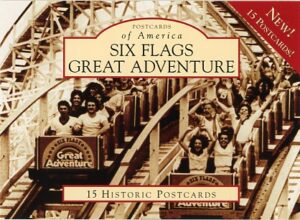 Compiled by Harry Applegate & Thomas Benton: Six Flage Great Adventure boasts a rich history. In this collection of vintage-photograph postcards, the authors explore the park’s past. Contains 15 Historic Postcards.
 -
 By John Calu and Dave Hart: With time running out, three intrepid summer adventurers, Kelly Martin, Geoffrey Martin, and Danny Windsor find themselves drawn into the epicenter of controversy as Mayor Dillard C. Webb, coping with unpopular beach closings, riots and demonstrations, must do battle with power mongers and political mercenaries in order to solve this Riddle in the Sand. This is a work of fiction.
 -
Out of stock
 By Karen L. Schnitzspahn: History is everywhere along the New Jersey Shore, from the lighthouses that dot the coast to the Victorian grandeur of Cape May. Less visible are the stories of the women who helped shape that past. Trailblazing young women in Belmar and Wildwood became lifeguards, proving that women were just as capable as men. Cindy Zipf has worked tirelessly for more than thirty years to stop ocean pollution and protect marine life. Theatrical stars, pioneering politicians, a Titanic survivor and a cosmetics entrepreneur all called the Jersey Shore home. Even several first ladies vacationed in towns along the coast. While countless women have contributed to the region's past, local author Karen L. Schnitzspahn chronicles some of the most intriguing stories of the remarkable women of the Jersey Shore.
 -
 By Karen F. Riley: The Pine Barrens of New Jersey cover 22 percent of the most densely populated state in the country. The name came from early settlers who thought the area was a vast wasteland, but it is anything but barren. Underneath this incredible natural resource lies almost 17 trillion gallons of some of the purest water on earth. The charcoal industry began here, cranberry production, cultivated blueberries were developed in this area. You’ll uncover many forgotten ghost towns but the people who lived and worked there are the real story.
 -
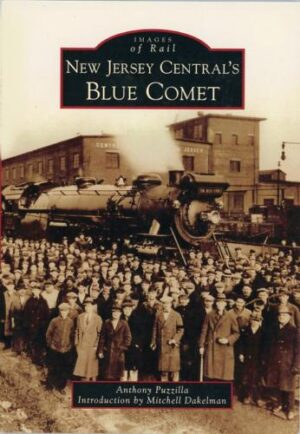 By Anthony Puzzilla: The legendary Blue Comet train no longer streaks through the pines of New Jersey. However, its memory still lives on through timeless images and the sustained efforts of historical societies and preservation organizations. The Garden State's Blue Comet passenger train service operated from 1929 to 1941, on a route from the New York metropolitan area to Atlantic City. This book contains memorable images, many from private archival photograph collections, showing the remarkable history of this classic train and of the many hardworking, dedicated people who made it all possible.
 -
 By Richard J. Garlipp, Jr.: In the 18th and 19th centuries, covered bridges dotted the landscape of New Jersey, providing safe passage to travelers. Forty-five covered bridges once crossed waterways in all corners of the state. Perhaps the most extraordinary examples of these wooden bridges were found along the western border, crossing the Delaware River into neighboring Pennsylvania. These bridges were feats of construction and engineering but were ultimately unable to prevent the inevitable fate of almost all the covered bridges of the state, namely ice, floods, and fire as well as the development of new materials and technology. Today, only one covered bridge survives in New Jersey. The Green Sergeant's covered bridge in Hunterdon County was constructed over the Wickecheoke Creek in 1872 and has stood the test of time. New Jersey's Covered Bridges showcases the rich transportation history of these structures and pictorially honors the lost ones.
Call Us Today! (732) 341-1880